Thornback Ray
By Alex Clayton · Updated 3 November 2026
The thornback ray is the ray most UK sea anglers catch first, and many know it as the roker. Plenty of angling pages quote a single “UK minimum size” for it. There isn’t one for anglers: local IFCA byelaws set the limit, and they differ, with Kent and Essex at 40 cm and the North West at 45 cm.
Get that wrong and you keep a fish you should have returned.
Below: how to identify a thornback, how big they grow, the size rules by district, where and when to find them, the baits and rigs for thornback ray fishing, and safe handling.
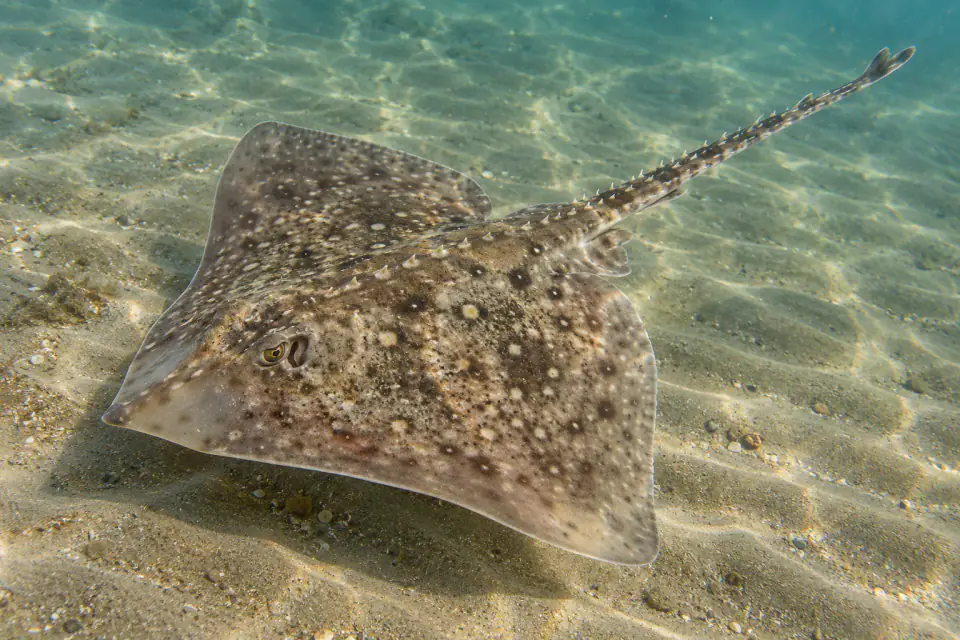
How to Identify a Thornback Ray (the Roker)
The name tells you what to look for. A thornback ray carries thorns (hard spines) across its back and along the tail, and they are sharp enough to pierce skin. That is the first reason to keep a pair of thick gloves in the tackle bag.
Many UK anglers call it a roker, and you will sometimes see thornback skate. All three names mean the same fish.
The body is the classic ray shape: a flattened diamond with broad pectoral fins, the “wings”, running out from the head. The upper side is mottled and patterned brown, and the underside is pale.
The sexes differ in size. Kent and Essex IFCA gives a maximum length of about 118 cm for females against about 98 cm for males, so the biggest thornbacks are usually females.
Several UK rays look alike at a glance, especially on wet shingle in a head torch beam. Check the back and tail for thorns before anything else. For side-by-side features of the other species, see the UK rays guide and the wider fish identification guide.
A ray with thorns on both the back and the tail is very likely a thornback. If you are not sure, photograph it and identify it later rather than guessing.
Size, Growth and Why Release Matters
A thornback ray can clear the local size limit and still be a fish that has never bred. That gap between legal and mature is why most anglers put them back.
Angling sources such as British Sea Fishing describe the thornback as slow-growing and late to mature, which leaves it vulnerable to overfishing. The same site reports that it is listed as Near Threatened by the IUCN.
Thornbacks lay their eggs in tough cases, the “mermaid’s purses” that wash up on the strandline. According to Planet Sea Fishing, the eggs are laid inshore between March and August.
Published record weights conflict between sources, so none are quoted here. For the current British record, check the British Record (Rod-Caught) Fish Committee list, or see our British fishing records guide.
If in doubt, photograph it and put it back.
Thornback Ray Minimum Size: IFCA Rules and How to Measure
The size you read on a forum or tackle site may not be the law where you fish. In England, minimum sizes for anglers are set locally by the Inshore Fisheries and Conservation Authorities (IFCAs) through byelaws. As Kent and Essex IFCA explains, local sizes can be stricter than national limits and differ from one district to the next.
Two IFCAs have a skate and ray size in force:
| District | Whole ray | Wing | How it is measured | Source |
|---|---|---|---|---|
| Kent and Essex IFCA | 40 cm | 19 cm | Whole ray wing tip to wing tip; a wing from its tip across to the cut edge | Minimum Sizes Byelaw |
| North Western IFCA | 45 cm | n/a | Between the wing tips | Byelaw 1 |
A Kent and Essex IFCA agenda paper states that only two IFCAs currently mandate a minimum size for skates and rays. It recommends a harmonised 20 cm wing and 45 cm whole ray across districts. That is a recommendation, not law.
Fishing anywhere else in England? Check your own IFCA’s byelaws before you keep a thornback ray. Wales, Scotland and Northern Ireland have their own regulators, so check with the Welsh Government or Natural Resources Wales, the Marine Directorate in Scotland, or DAERA in Northern Ireland.
To measure, lay the ray flat on its belly and run the tape across the widest span, from one wing tip to the other. Under the Kent and Essex byelaw, a fish below the minimum size must be returned immediately.
Check before you keep. Nothing on this page replaces the current byelaw for the water you are standing beside.
Where and When to Catch Thornback Rays
Fish clean ground after dark between spring and autumn and you are in the thornback’s window.
British Sea Fishing reports thornbacks around the UK and Ireland on sandy, muddy and shingle seabeds and on clear patches among rock. They are scarce along much of the east coast of Scotland and England.
Depth explains why both shore and boat anglers catch them. Planet Sea Fishing gives a usual range of 10 to 60 m, down to 300 m, and British Sea Fishing notes that they move shallower in summer.
Thornbacks lie buried in the sand by day and feed mostly after dusk, so evening and night tides are the usual target. Our tides for sea fishing guide helps with timing.
For season, the official picture comes from Kent and Essex IFCA. Thornbacks are present across most of its district from early spring to late autumn, have been seen further up rivers in summer in recent years, and stay year-round in places. That is one district. Elsewhere, local tackle shops and club catch reports are the best guide.
The same IFCA page sets out the diet. Young thornbacks eat small crustaceans, and adults take swimming crabs, sandeels and small gadoids (the cod family), which points straight at the baits below.
Thornback Ray Fishing: Baits, Rigs and Hooks
A long snood, a strong small hook and an oily fish or crab bait cover most thornback ray fishing. The setup below follows the approach described by British Sea Fishing.
- Tie a clipped-down long-and-low rig (also called up-and-under). Clipping the bait down streamlines it for the cast, which matters when the clean ground is a long way out. Our clipped-down rig guide shows the build.
- Use an extra-long snood so the bait settles on the seabed well away from the grip lead’s wires.
- Choose a heavy-gauge hook from 1/0 to 3/0. Thornbacks have a small mouth with crushing plates, so a strong, compact hook suits them better than a large one.
- Switch to a plain lead where the tide allows.
| Bait | When it works |
|---|---|
| Mackerel, bluey, herring | The main baits; all oily fish |
| Sandeel | A main bait that matches the natural diet noted by Kent and Essex IFCA |
| Peeler crab | Spring |
| Ragworm, lugworm, squid | Later in the season |
| Prawns | Listed as a good bait by Planet Sea Fishing |
For preparation and presentation, see mackerel bait, peeler crab and the wider sea fishing bait guide.
Thornbacks can move in shoals, so after a fish, get a fresh bait back out to the same spot quickly.
Best for: clean sand, mud or shingle at dusk and into the night. Skip if: you are fishing heavy rough ground, where an extra-long snood is likely to tangle and snag.
How to Handle and Release a Thornback Ray
The thorns that give the fish its name are the first thing you feel if you grab one bare-handed. These steps follow the handling advice British Sea Fishing summarises from a European ray handling sheet.
- Wear thick gloves. The thorns on the back can pierce skin.
- Unhook with pliers or a disgorger, keeping your fingers clear of the mouth and spines.
- Support larger rays under the pectoral fins, keep the fish wet and keep it out of the sun.
- Never stack rays on top of one another, on the deck or on the beach.
- Measure quickly using the wing tip to wing tip method in the minimum size section above, then return the ray promptly.
A thornback ray that goes back fast, wet and supported has the best chance of recovering. There is more general advice in our catch and release guide, and the species guides cover the other fish you are likely to meet on the same ground.
Frequently asked questions
What is the minimum size for a thornback ray?
There is no single UK minimum size for anglers. Local IFCA byelaws set it: Kent and Essex IFCA uses 40 cm whole ray, measured wing tip to wing tip (19 cm for a wing), and North Western IFCA uses 45 cm between the wing tips. Check your own IFCA, or your national regulator in Wales, Scotland or Northern Ireland, before keeping one.
Why is a thornback ray called a roker?
Roker is a common alternative name for the thornback ray, widely used by UK sea anglers. You may also see it called the thornback skate. All three names refer to the same species, which you can recognise by the thorns along its back and tail.
When is the best time to catch thornback rays?
Kent and Essex IFCA reports thornbacks across its district from early spring to late autumn, with some present year-round. They lie buried by day and feed mostly after dusk, so evening and night tides over clean sand, mud or shingle are the usual target. Seasons vary elsewhere, so check local catch reports.
What is the best bait for thornback ray?
Oily fish such as mackerel, bluey and herring, plus sandeel, are the main baits. Peeler crab works well in spring, and ragworm, lugworm and squid later in the season. Fish them on a 1/0 to 3/0 heavy-gauge hook with an extra-long snood.